
The American discourse on "class" is a mess. It seems like everybody has their own private meaning of the word and not just at the boundaries of the term, but also regarding many core aspects of it. In debates about how to sort contested individuals into one class or another, the normal mode of engagement is to provide a fuzzy mini-narrative about someone's life and then conclude that something about that narrative makes it obvious what the person's class must be. The best way to predict what someone is going to conclude about what class a contested individual belongs to is to first determine whether they, for unrelated reasons, like or dislike the person. Somewhat bizarrely, when people have favorable inclinations towards someone, they tend to say they are lower class, and when they have unfavorable inclinations, they tend to say they are higher class.
Some of this just reflects the usual bad faith and motivated reasoning that infects any sort of political discourse. But some of it also just reflects the slipperiness of the term. People conflate economic class and social class, but also define each of those sub-concepts differently. Within conventional usage, there are many different indicators of class, which means it is possible, and in fact common, for the same person to have a mix of indicators that point in different directions. For example, someone can have a high education and a low income, a high job and a low education, a low childhood and a high adulthood, or high wealth and a low job.
There are divergent opinions about which of the various indicators should be used in an assessment of class, what weight to give each of them if you decide to use multiple indicators, and whether to use a conjunctive assessment (i.e. all of the indicators have to be low for someone to be low class) or a disjunctive assessment (i.e. only one of the indicators has to be low for someone to be low class).
Socioeconomic Status
Sociology came up with the concept of socioeconomic status (SES) to try to cut through these challenges. Rather than defining class by a single variable, which does not seem to reflect how our current society treats the idea, SES is defined by an index that combines multiple variables together into a single number. SES is not a discourse-friendly approach to the question because it effectively treats class as a spectrum when the discourse really craves discrete buckets. With SES, you could say that someone is at the 20th percentile of the "class" distribution, but not that they are "lower class" or "working class" or "professional class." So, although it kind of solves one of the problems that plagues this discourse, it does so in a way that is simply incompatible with the ways people have become accustomed to talking about the topic.
SES indexes typically combine education, income, and occupation variables together into a single number. When other variables like wealth, family background, or consumption are available, they might get rolled in as well. To get someone's SES index number, you first find the average of each of the indicators and then measure how far above or below an individual is from that average. You then sum or average their score on each of these sub-indicators to get their overall score. From there, you can compare their overall score to the total distribution of overall scores and determine whether they are, say, in the bottom 10 percent of the SES distribution, the top 1 percent, or at the median.
When I first learned about SES in college, I thought it was pretty clever and elegant. The income-education-occupation SES index does a good job of registering that, in our society, people are frequently tripped up by the fact that these things don't always align, which endlessly frustrates class discourse.
Many want to be able to say that someone with a PhD who earns $80,000 per year as a college professor really is in a higher "class" than a high school graduate who earns $100,000 per year as a plumber. In fact, many want to be able to say that even if the PhD becomes a $100,000/year plumber, he is still in a higher "class" than the plumber who only has a high school degree. On the flipside, I think mostly we don't want to say that someone with a college degree who works for low wages in retail or food service is in a higher class than someone without a college degree who is a high-paid corporate executive.
Income-only, education-only, or occupation-only definitions of class would not allow us to generate these preferred conclusions. But an income-education-occupation SES index potentially does as it gives weight to all three of the indicators on the theory that each contributes to one's class, but is not solely determinative of it.
Doing an SES analysis, and then decomposing its parts, is also a good way to illustrate how the discourse gets so tripped up about it. In the below graph, I have implemented an income-education-occupation SES measure and sorted all individuals between the ages of 25 and 54 into SES deciles. Within each decile, I have graphed three pillars that show the range of outcomes on the three sub-indicators that are present in that decile.
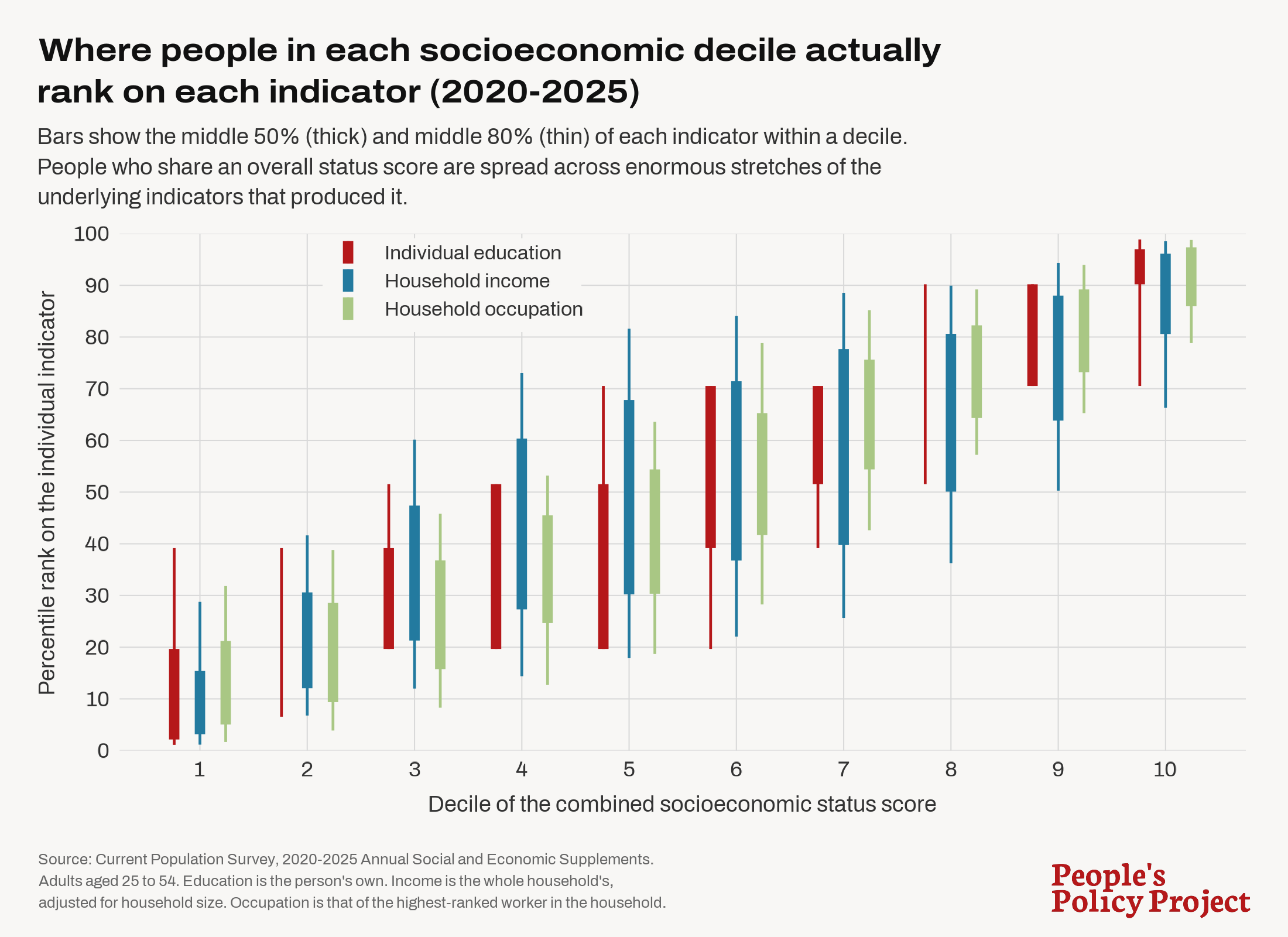
The overall shape of the plot looks like you would expect it. As we move up the SES distribution, the three pillars also tend to move up the percentile distribution. But still there is quite a big range for each of the sub-indicators within each decile. It is easy to see how, if you were looking at a particular individual who was low SES, you could often find that one of the sub-indicators was actually on the higher end of things. And if you adopted a conjunctive approach to defining low "class," you would be able to fixate on that one indicator and declare that they are not actually low class.
And this is with an analysis that only combines three sub-indicators to construct the SES index. If we were to start adding in more — in the discourse, there seem to be dozens of indicators people invoke — then the number of people for whom literally all possible indicators are low becomes vanishingly small.
We Should Argue More About Indicators
So far, I have tried to provide a descriptive account of how people actually talk about "class" in the discourse. It's a jumbled mess. But we probably should spend a bit more time actually arguing with people about the contours of class, especially when they have very boutique and unworkable approaches to it.
For example, Noah Smith wrote a piece titled "I Have Never Been Working Class" in which he advances this definition of class:
Why not? Because I have never thought of class as being defined by a present snapshot of someone’s lifestyle or material circumstances. Instead, I always thought of class as being about someone’s potential. And I grew up always knowing that my economic potential went far beyond the rather humble circumstances of my early childhood.
Under this definition, it would seem as if there is no such thing as upward class mobility. Nobody can rise from the lower class to the upper class in American life. After all, anyone who winds up in the upper class necessarily had the potential to do so, and if they had the potential to do so, then they were never lower class to begin with.
Also, this potential-based definition of class would seemingly permit people to belong to many classes at the same time. Many children have the potential to wind up as upper class or lower class in adulthood. So does that mean that they are in both classes simultaneously?
This is a bizarre approach to defining the term and I suspect that, despite writing this, Smith doesn't actually think this makes any sense. If you read on in his piece, what he actually seems to be grappling with is the fact that, despite being low income and low consumption, his household was high education and high occupation (his father had a PhD and was a professor). This, of course, is exactly the insight that the SES index above already elegantly captures without a detour into this weird talk about "potential." The problem is only that SES would average out these four indicators and put Smith's childhood household somewhere around the 50th percentile of the SES distribution, which is only a problem because people want discrete buckets with discrete names like "working class," not a place on a percentile chart.
Class as Economic Dependency on the Labor Market
When dealing with the left especially, some allowance should be made for the Marxist conception of class, even though that departs from the murkier way it is used in the current society. Within this usage of the term, the phrase "working class" refers to people who are economically dependent on the labor market. If you don't like giving the socialists that phrase, it is important to at least acknowledge it as a discrete concept and idea. Otherwise, you will struggle to understand what socialists are even talking about a lot of the time.
Under this notion of "working class," things like education, occupation, how you dress, your accent, your potential, and whatever else are not particularly relevant. This is not because those things have no relevance to other aspects of life. It's just that they do not tell us whether someone is economically dependent on the labor market or not.
The precise boundaries of this sort of economic dependence will be fuzzy and people will naturally argue about specific thresholds. In my view, a good approximation is anyone who has less than 20 times the average income in return-generating wealth. But others obviously have different thresholds or different ways of approximating economic dependence.
Within the socialist telling, people who are economically dependent on the labor market occupy a unique role in society in that they are similarly vulnerable due to their subordinate economic position and similarly powerful due to their ability to halt production. From this, many things supposedly follow about how the society could be transformed if this group were united and worked together to advance their interests as the "working class" so defined.
You don't have to believe all that to at least acknowledge that it is a long-running idea that many others have believed and still do believe. If you can ignore the semantic collisions, it should be obvious that there is room for a world where that concept of "working class" exists alongside broader concepts of "social class" or "social status."