

Democratic voters overwhelmingly support the public ownership and operation of several key industries. At least one of the Democratic politicians who want to win the party’s next presidential primary should take note.
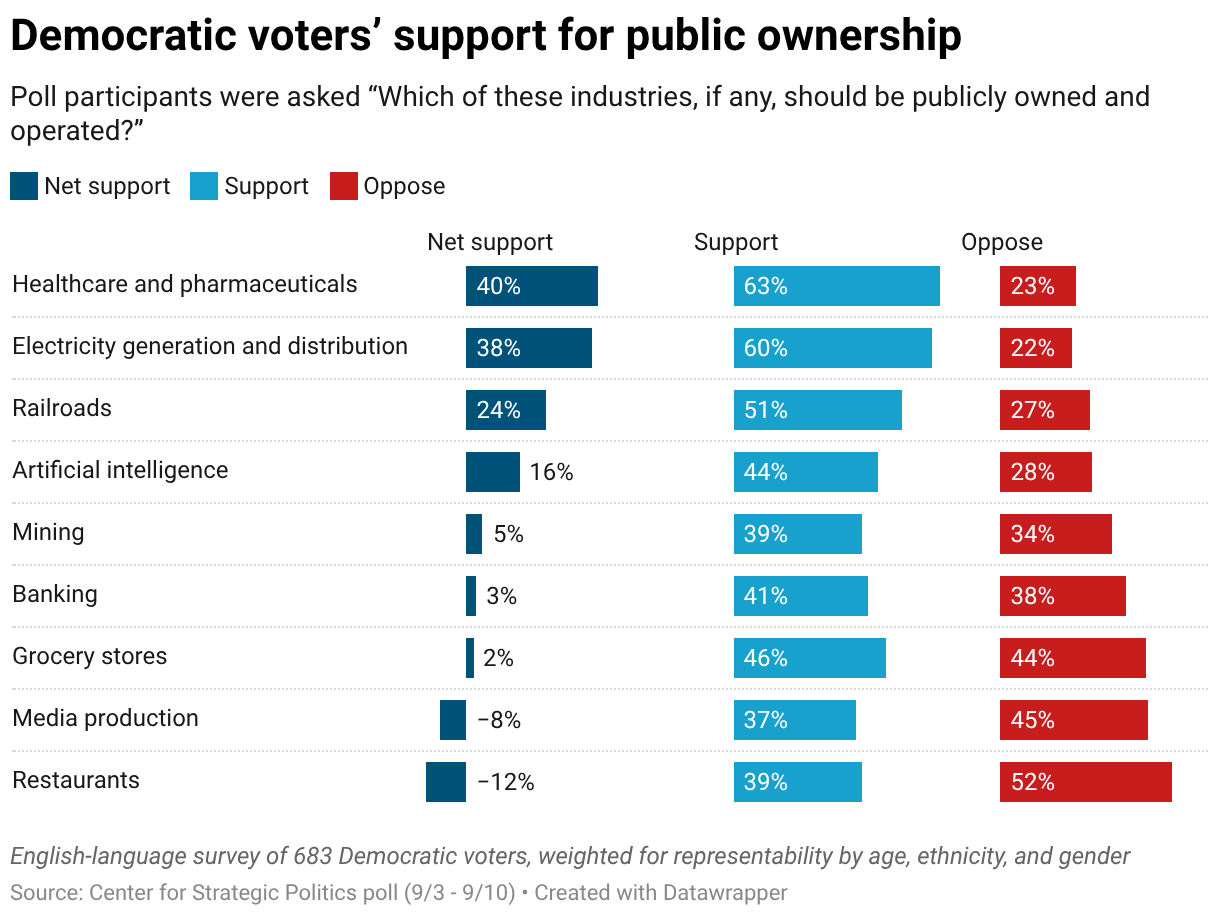
A poll I recently commissioned from the Center for Strategic Politics found that a supermajority of Democratic voters support public ownership and operation of healthcare and the electrical grid. A slight majority supports public ownership of the nation’s railroads. And far more voters said they would support public ownership and operation of artificial intelligence than opposed it.
Per other polling conducted back in June, Bernie Sanders’ proposal to partially nationalize AI companies is also incredibly popular across the political spectrum. Maybe it’s the number of socialists holding public office now, or maybe it’s the Trump administration’s habit of demanding stakes in private companies, but public ownership isn’t all that taboo anymore. Not if you trust the polls.
And at least in American politics, polling has been having a moment for the last few years. Political consultants and talking heads are paid handsomely to tell politicians and partisans of both parties that they really need to consult the latest polls before deciding how they’ll campaign.
Besides the inherent issues with such an approach, polling is usually a poor way to find a novel policy proposal or a topic that candidates could win a campaign by bearing down on. Asking hundreds or thousands of prospective voters a battery of questions quickly becomes quite expensive, and while the marginal cost per question isn’t especially high, most polls focus on policy areas that are already salient. Ergo, we don’t see many polls that directly ask whether voters would support nationalizing parts of the economy, aside from questions about Medicare for All. But we do know that nationalization can be very popular.
Across gender, age group, ethnicity, and political leaning, and across polls, the economy or the cost of living is by far the issue cited most frequently as deciding Americans’ votes. Even when socialization doesn’t have any real ideological appeal for voters, pitching public ownership as a cost-of-living measure has proven to be politically effective. Just look at New York.
The poll I commissioned showed that grocery stores are one of the industries Democrats are least interested in taking into public ownership, but piloting municipally owned groceries was a key platform plank of the wildly successful Mamdani mayoral campaign. It polled quite well during the campaign and, despite significant pushback, is one of the campaign promises that Mamdani is currently working to keep.
Calls for a larger public stake in or full public ownership of other industries are far more likely to be political winners: thanks to the Hugging Face hack and similar fiascos, the public is increasingly concerned about recent developments in artificial intelligence. The war with Iran and increased demand are driving up electricity prices across the United States. And private healthcare and health insurance are just inherently disastrous.
Right now, Democratic voters still haven’t fully lined up behind any of the major presidential hopefuls. The largest bloc across almost every poll says it will support Kamala Harris, but a half-dozen other candidates are also polling relatively well. Most notably, democratic socialist Congresswoman Alexandria Ocasio-Cortez usually ends up in the top tier of serious contenders.
The poll results suggest that a properly motivated political entrepreneur could benefit from the American cost-of-living crisis quite easily. Just call to nationalize the industries that Americans want to see nationalized. If, as Substacker Matthew Yglesias suggests, the politically minded “should encourage candidates to embrace popular progressive causes,” then we should encourage candidates to embrace nationalization.
Now, maybe ambitious Democrats should not call for the nationalization of restaurants, but at a minimum, the government taking a leading role in the rapidly developing AI sector and large swaths of the private healthcare system appears overwhelmingly popular. As a vision to rally around, it would at least help secure them the nomination.