

As the start of the 2028 Democratic presidential primary nears, various policy institutions will offer up healthcare proposals for candidates to adopt. One such organization, the Searchlight Institute, jumped the gun a few months ago when it released Making Health Care More Available, a package of reforms headlined by a proposal to make primary care free for everyone. Overall, I find the Searchlight Institute's proposal to be generally overstated in its significance and quite strange and cruel in its particulars.
Free Primary Care For All
Whenever someone goes to the doctor, the bill they receive is paid either directly by them out of pocket, by their insurer, or through some combination of the two. The precise payment mix is determined by the cost-sharing rules contained in health insurance plans, which vary from policy to policy.
The Affordable Care Act established a list of ten essential health benefits (EHBs) that must be covered entirely by health insurers without any out-of-pocket cost-sharing for individuals. The Searchlight proposal would simply add primary care services as the eleventh EHB.
To evaluate the significance of this proposal, we need to know what percentage of current health spending goes to primary care services that are paid for out of pocket. The short Searchlight paper does not provide a definition of primary care services. So, for my analysis, I have adopted the definitions used in the Milbank Memorial Fund's Primary Care Scorecard.
In the Milbank scorecard, author Yalda Jabbarpour provides both a narrow and a broad definition of primary care, which I replicate in the graph below.
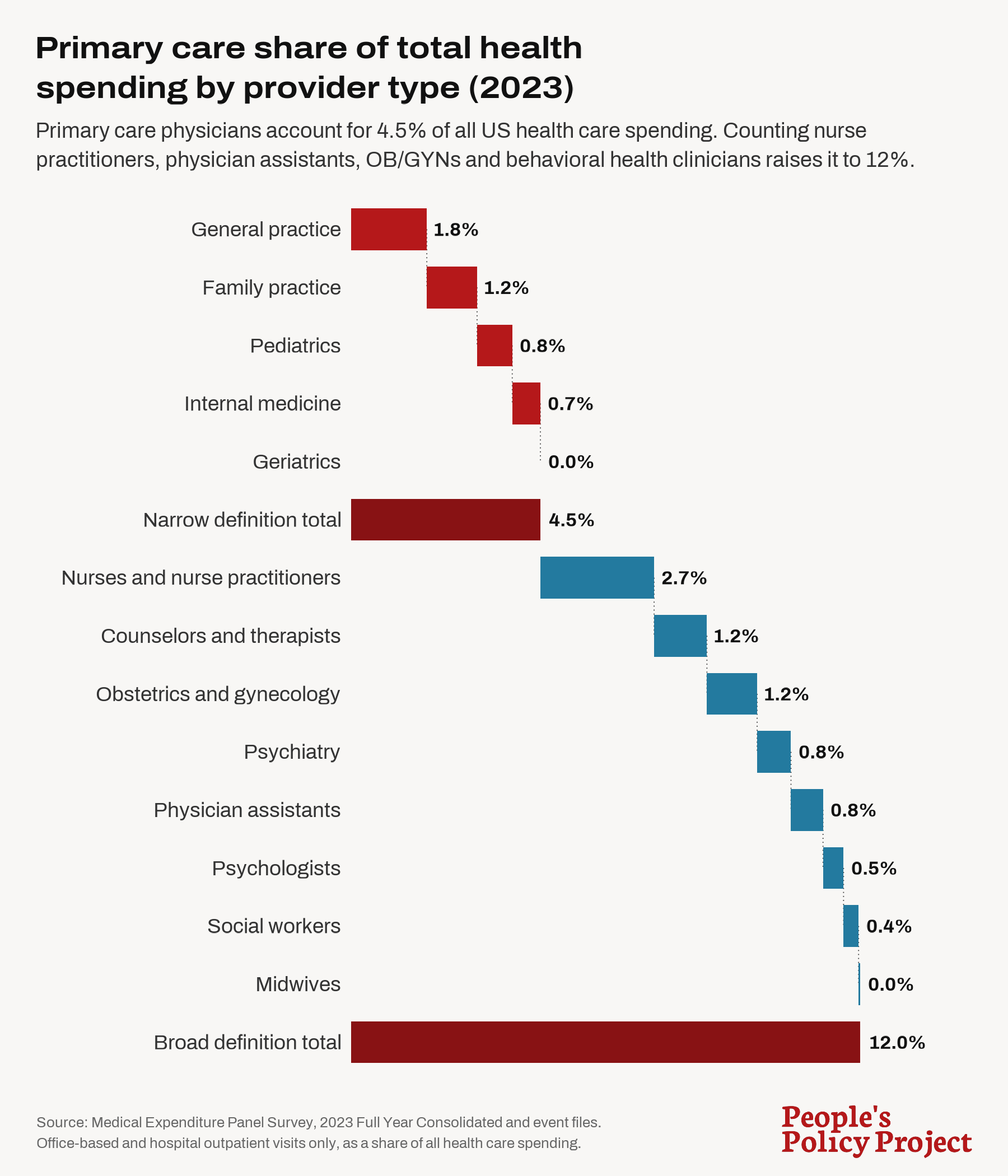
Under the narrow definition — which includes general practice, family practice, internal medicine, pediatrics, and geriatrics — primary care makes up 4.5 percent of total health spending. Under the broader definition, the number goes up to 12 percent.
The vast majority of this spending (85 to 87 percent) is already paid for by insurers, not by individuals out of pocket.
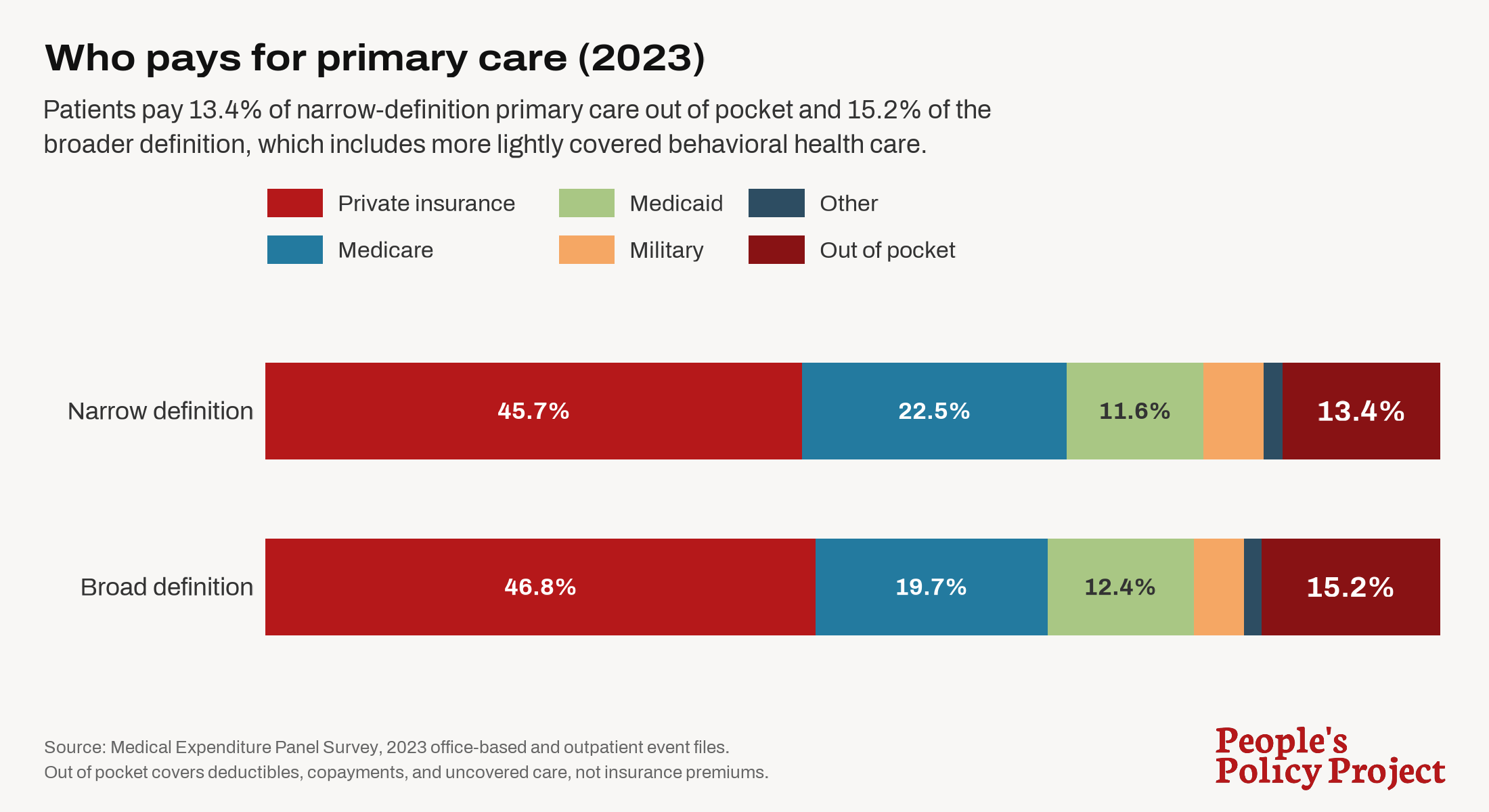
When you add it all up, out-of-pocket primary care spending amounts to just 0.6 percent (narrow) to 1.8 percent (broad) of all health spending. This is a drop in the bucket and, if this proposal is implemented, households will end up paying higher premiums to make up for the increased insurer payouts, making it a wash overall with some winners and losers. This is not a bad thing to do, but it is fairly trivial in the grand scheme of things.
Public Option
Searchlight's second proposal is to create something called the American Health Gateway, which it calls a "nonprofit coverage option," but which reads like what people normally call a "public option." This public option would (1) compete in the ACA exchange market, (2) compete in the Medicare Advantage market, and (3) be available (for free?) to low-income individuals in states that have not expanded Medicaid.
Below, I have plotted the current distribution of health insurance in the United States and shaded as teal the population where this public option would conceivably be available.
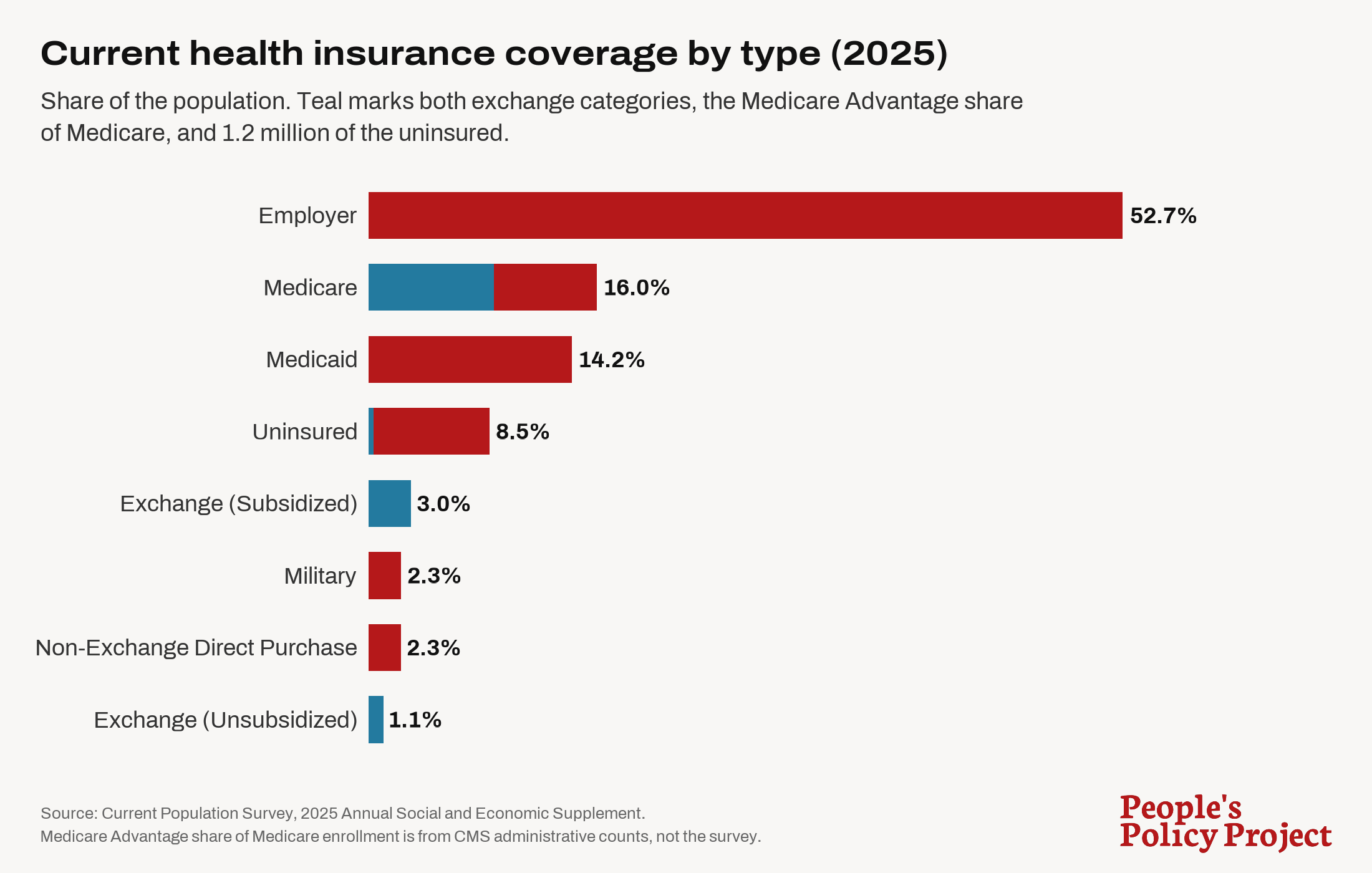
The potentially affected individuals make up around 13.2 percent of the overall population, with two-thirds of that coming from Medicare Advantage. Of course, not everyone in these groups will switch to the public option, so the percentage of people who would be directly served by it would be much smaller than that.
There are a couple of really strange things about this proposal.
First, if you are going to create a public option, why wouldn't you make it available in the employer market, which is the largest market private insurers operate in? If you are going to make it available in the Medicare Advantage market, why wouldn't you also make it available in the Medicaid MCO market, which is, for all relevant purposes, essentially the same thing?
Second, if you are going to create a public Medicare Advantage plan, why not just create that inside the Medicare program itself? The private insurers that operate in the Medicare Advantage market are basically criminals, but seniors nonetheless like the idea of an all-in-one insurance plan that incorporates Medicare Parts A, B, and D. The obvious solution to that would be to cut out the fraudsters and have CMS offer its own Medicare Advantage-type plan, not to create yet another health insurance entity.
There is something also quite comical about the Medicare Advantage aspect of the plan. When you run the clock back, what you see is Congress inviting private insurers to administer Medicare plans and then this whole thing turning into a vehicle for defrauding the government out of tremendous sums of money. Now, our policy response to this is to see if the American Health Gateway can somehow convince the nation's elderly to turn away from whatever Medicare Advantage plan Joe Montana is hocking on daytime TV in favor of the American Health Gateway, which sounds just as scammy if not more so. This is needlessly circuitous, at best.
Restoring Biden-Era Exchange Subsidies, But Only For Some People
Individuals who receive their insurance through an exchange receive an income-based subsidy. During the Biden administration, that subsidy was increased a bit. That increase lapsed in 2025, bringing the subsidy back down to pre-Biden levels. As with most other organizations, Searchlight proposes returning to the Biden-era exchange plan subsidy levels. Unlike most other organizations, Searchlight proposes only doing so in states that have adopted Medicaid expansion.
In the graph above, we can already see what share of the population is on an exchange plan. It is 4.1 percent. This proposal targets them except that it excludes those who are in one of the ten states that have not expanded Medicaid. This exclusion knocks out 41.4 percent of exchange enrollees.
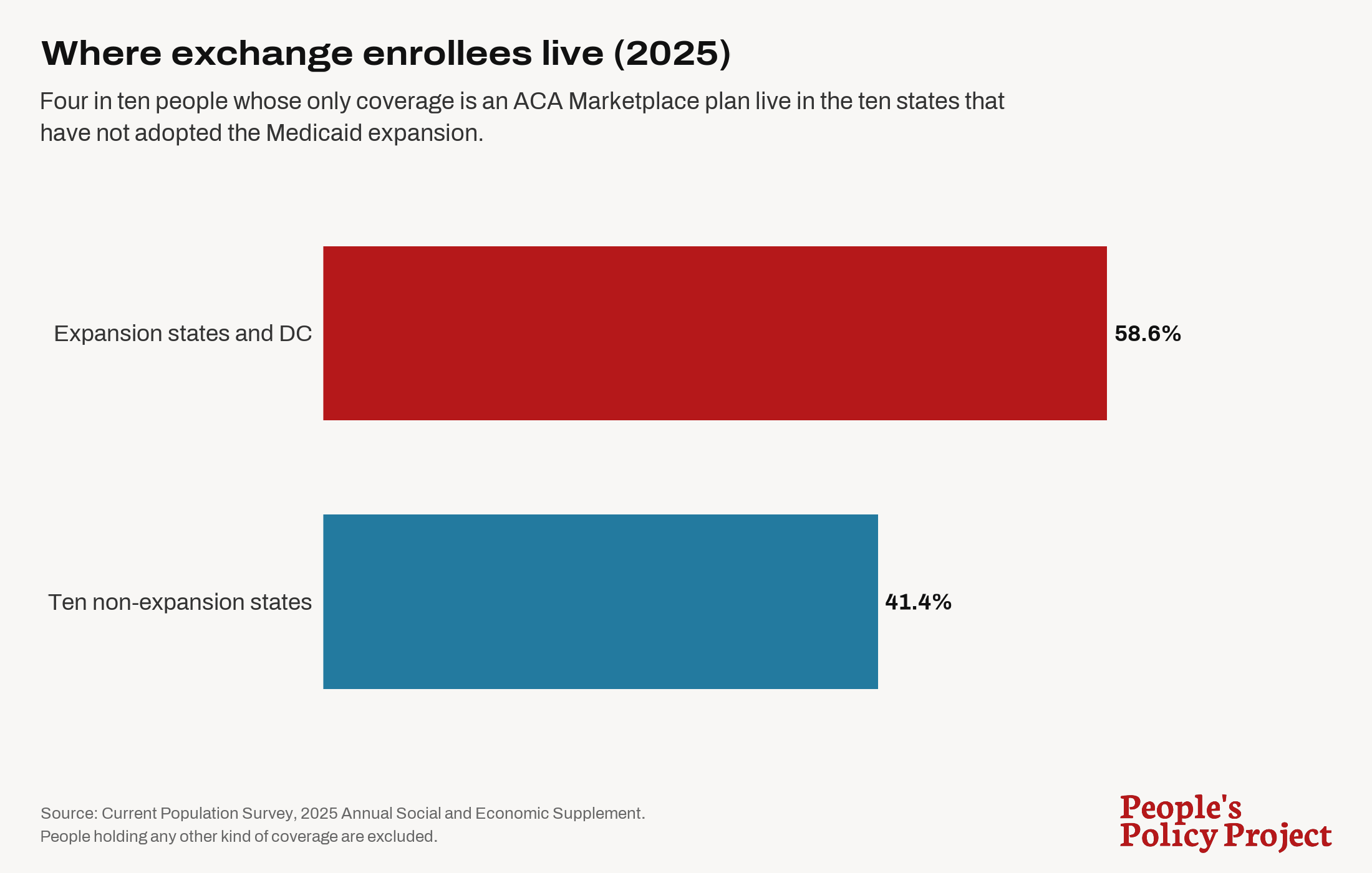
Once we remove these sacrificial pawns, we are left with only 2.4 percent of the population that is in an exchange plan in a covered state. Some fraction of those earn so much money that they would not receive subsidies even if we returned to the Biden-era subsidy levels.
This is an extremely bizarre proposal, especially when presented alongside the public option proposal above. Taken together, what we have is:
- A (presumably free) public option for individuals caught in the Medicaid coverage gap due to their state not expanding Medicaid.
- Expanded exchange subsidies for individuals except for those living in states that did not expand Medicaid.
The given rationale for the latter is that "America should not continue to subsidize states that fail to take responsibility for the health care needs of their people." But then the first proposal does exactly that.
Beyond the logical inconsistencies, on the merits, it is hard to understand how it makes sense to punish individual exchange plan enrollees for the sins of their state government. There also is no chance that any of these holdout states expands Medicaid in response to this incentive. If you really wanted to go down this route, how about increasing the top marginal tax rate to 90 percent in states that did not expand Medicaid? That might actually get state legislators moving and put the target on the rich, not on low- and middle-income exchange plan participants.
If you wanted to keep the punitive measure topically related to healthcare, why not also reduce or eliminate the federal subsidies for employer-sponsored insurance, Medicare, and military healthcare in non-expansion states? Surely that makes more sense than a random potshot at people who don't have access to an employer health plan.
Add "Loved Ones" To Health Plan
The next Searchlight proposal is to remove the current related-family rules for who can be added to a health care plan in favor of allowing plan holders to add to their policy "a loved one who is not related but is still family in their hearts." Unless we are going to be adjudicating whether someone really is or is not someone's "family in their hearts," this amounts to a rule that anybody can add anyone to their health care plan.
The number of "loved ones" you are allowed to add is capped at double the number of people the current version of the health plan allows, such that single plans could have the policyholder plus a "loved one" while individual-plus-spouse plans could have the policyholder, their spouse, and two "loved ones." The proposal does not spell this out, but insofar as family plans theoretically permit an infinite number of children, it would seem individuals with those plans could add an infinite number of "loved ones."
The proposal makes clear that insurers would be allowed to raise the premium to match the extra enrollees. So, ultimately, this just amounts to the ability of some people to add some other people to their own health plan at cost, which I guess is fine, even if small-bore.
The Usual Handwaves
Finally, the Searchlight document ends with what I would call the usual under-explained handwaves. We get a broad commitment to cut red tape, to fight fraud and abuse, and to expand healthcare supply via telehealth, AI, foreign doctors, and so on. Again, fine as far as it goes, but not all that significant in the grand scheme of America's healthcare dysfunction.
Conclusion
Ultimately, the Searchlight proposal is far to the right of not just what Bernie Sanders ran on in 2020, but also what Pete Buttigieg ran on in 2020. It does not eliminate uninsurance and does little to nothing to cut down on excess administrative expenses and provider rents. It is clearly inferior to a Medicare for All type system on all the relevant policy axes.
The point of this proposal seems to have been to generate a flashy headline about free primary care for all, which it did, but that headline policy amounts to almost nothing and the overall grab bag of proposals is internally contradictory, cruel in places, and simply not up to the task at hand.